History of the Amsterdam Lending Library
For more than three decades, the Amsterdam Lending Library at 129 South Main Street in Amsterdam, Ohio served as a place to read, learn, and gather. What began as a simple idea in the 1980s grew into a true community institution—built entirely on generosity, volunteer work, recycling, and a love of books.
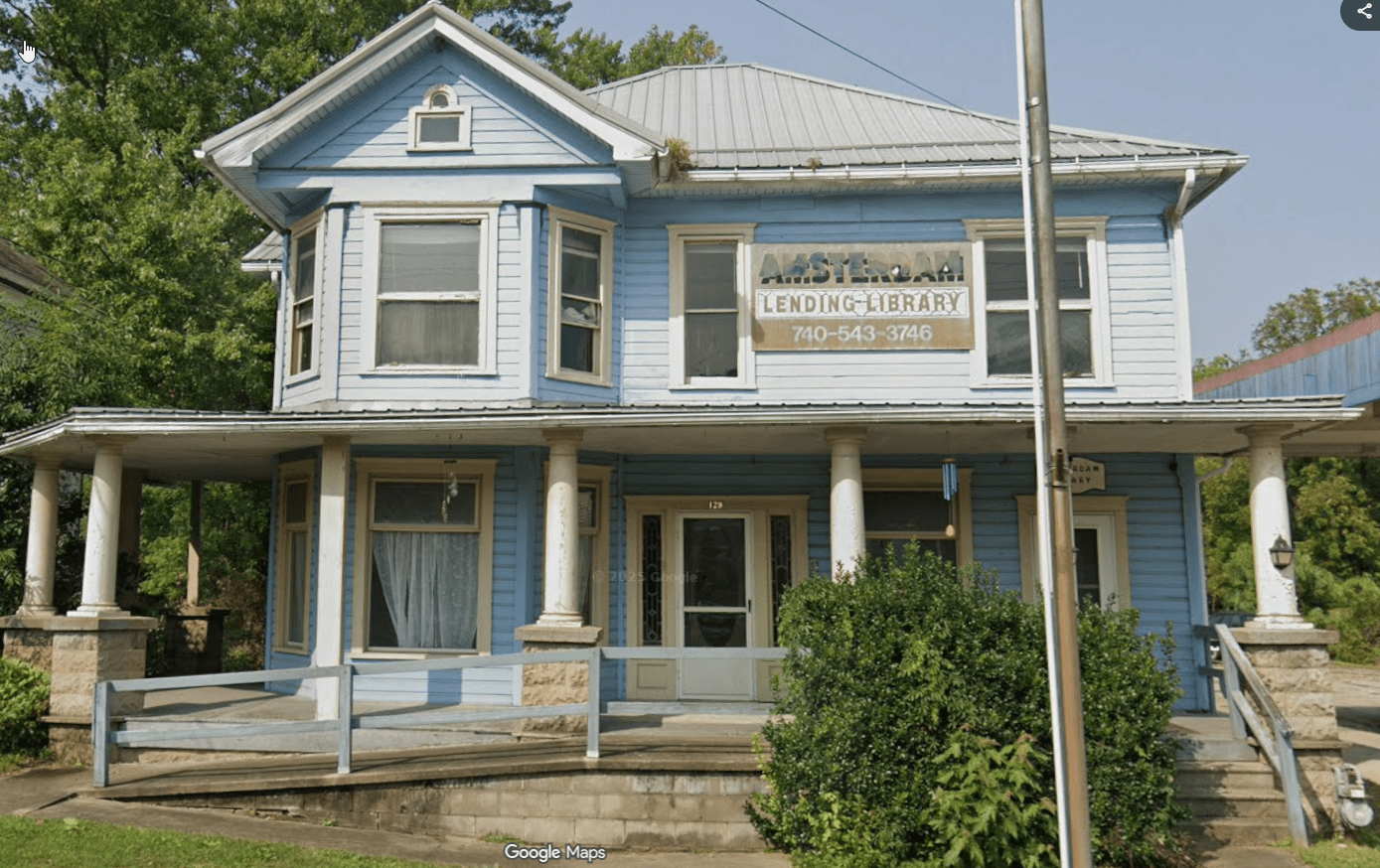
The Amsterdam Lending Library at 129 South Main Street in Amsterdam, Ohio. The original sign still hangs above the porch.
How It All Started
The Amsterdam Lending Library began with a conversation between Doug Dock and then–Mayor Michael Morgan in the early–mid 1980s.
When Doug asked what the village needed most, Mayor Morgan’s answer was simple:
“A bookstore or a library. Something for the people.”
That wish became the spark.
Doug approached local businessman John Allensworth, who owned a furniture and hardware store in town. Doug asked if he had any space that could be used for a small library. John did more than offer space—he generously gave Doug access to one side of a duplex house behind his store.
That house, with three rooms and a bathroom, became the first home of the Amsterdam Lending Library.
A Gift of Property & the Recycling Center
Not long after the library opened, John Allensworth returned with an even bigger gesture.
He decided to deed the entire property to the library’s nonprofit:
- The house, located in Jefferson County, which served as the library
- A four-bay garage, located just over the line in Carroll County, which became a recycling center
The recycling center was organized with four bays for cardboard, newspapers, cans, and plastics. Irene Saho played a major role, putting in a significant amount of time handling both the library and the recycling operation.
Once materials were recycled, the money from the recycling went directly toward operating the library. That funding, combined with volunteer labor and donations, helped keep the doors open.
This donation ensured the library and recycling center had a stable home for decades.
How the Library Operated
The Amsterdam Lending Library operated very much like a small public library:
- Anyone could come in and browse the shelves
- Patrons could check out books and VHS movies
- Items were borrowed and returned on a simple honor system
What made the library unique was how it was built and funded:
- All books were donated. Over the years, the collection grew to several thousand books, covering children’s stories, fiction, non-fiction, school materials, and reference works.
- VHS movies were available to borrow. This made the library a little entertainment center as well as a reading room.
- No tax money supported the library. It was powered by donations, volunteer work, and the income from recycling.
Programs and Community Impact
Over the years, the Amsterdam Lending Library became far more than a book room. It hosted programs that touched every corner of the community.
Summer Reading Program
For many years, Sallie R. Curry ran the summer reading program. Children from Amsterdam and surrounding areas came to read, do activities, and discover the joy of books during the school break.
GED Classes
The library hosted GED classes for adults who wanted to complete their education, giving many local residents a second chance at a diploma.
Christmas Toy Giveaways
Volunteers collected and purchased toys, wrapped them, and gave them away to local children. For many families, the Christmas giveaway at the library was a bright spot during the holidays.
Community Education Week
The library also hosted educational events for kids that introduced them to community helpers and public services. Over the course of a week, children could learn about:
- EMTs
- Firefighters
- Police officers
- School bus safety
- (Plus one more topic now lost to memory)
Recycling Program
The four-bay garage behind the library functioned as a village recycling center. Residents dropped off cardboard, newspapers, cans, and plastics. Thanks in large part to Irene Saho’s efforts, the proceeds from recycling went back into funding the library’s operations—a very local, very practical way to keep it going.
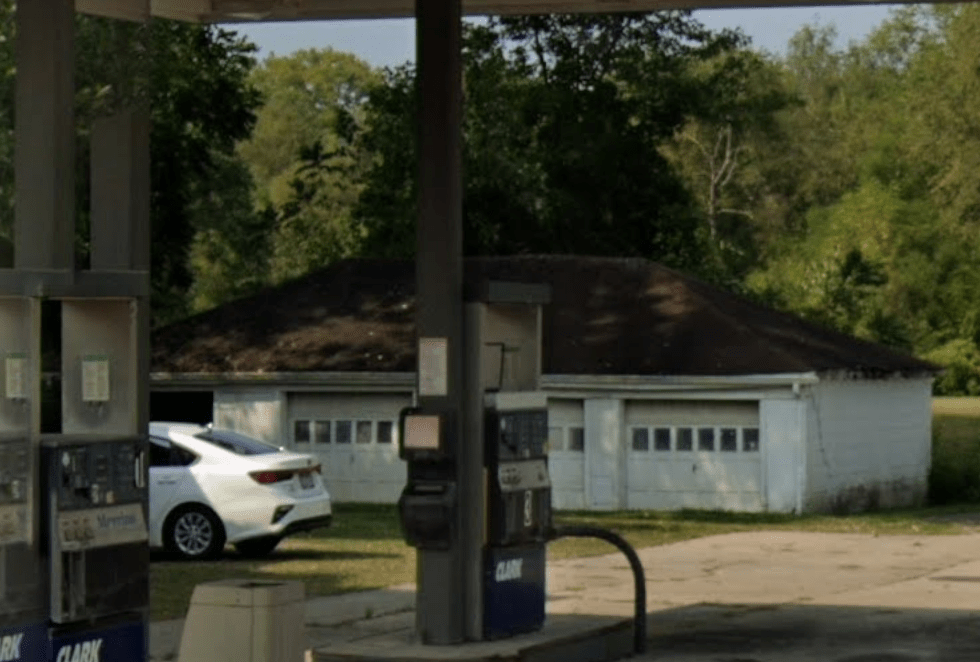
The four-bay garage behind the Amsterdam Lending Library, used for the village recycling program. Proceeds from recycled materials helped fund the library’s operations.
The People Behind the Library
The Amsterdam Lending Library was guided by a Board of Trustees and run entirely by volunteers.
Founder & First President
- Doug Dock – Founder and Board President, actively involved in day-to-day operations for the first 8–10 years.
Early Board Members
- Melanie Payne
- Louie Payne
- Irene Saho – Put significant time into both running the library and managing the recycling program whose proceeds supported the library
- Avis Stewart
- Sallie R. Curry – Later ran the library and its summer program for many years
- Tina (Suzanne) Reho
- Donna Snyder
- Ann Wiley
- Leanne Dunlap – Pastor of the Amsterdam United Methodist Church
- Norma Jean (Wilson) Smith – Local educator and founding board member
Over time, Sallie R. Curry and Irene Saho became especially central to the day-to-day operation of the library and its programs.
The Levy That Couldn’t Stand
At one point, a library levy was placed on the local ballot to provide tax-based support for the Amsterdam Lending Library.
The levy passed—a clear sign that the community valued the library.
However, after further review and discussion, it was determined that the library’s legal structure did not qualify as a public library able to receive tax or levy funds under Ohio law. Because of this technical issue, the levy was not permitted to stand, and the library continued on without tax funding.
The Amsterdam Lending Library remained what it had always been: a community-built, volunteer-run, donation- and recycling-supported library.
The Time Capsule
On Arbor Day, a tree was planted in the front yard of the library at 129 South Main Street. During the ceremony, a time capsule was buried beneath the tree.
The tree is now gone.
It is not known whether the time capsule was ever recovered—or whether it still rests quietly in the ground in front of the former library building.
Closing and Sale
After approximately 35 years of service, the Amsterdam Lending Library closed around 2020–2021.
The property was sold after the closure. Public details about who purchased it, the sale price, or how nonprofit proceeds were handled are not currently known.
Today, the building can still be recognized by the faded “Amsterdam Lending Library” sign on the front—one last visible reminder of what once took place inside.
Legacy
From its beginnings in a donated duplex to its decades of service as a volunteer-run nonprofit, the Amsterdam Lending Library represents the best of small-town community spirit.
It was:
- A place where children learned to love reading
- A place where adults earned their GEDs
- A place where families received Christmas gifts
- A place where neighbors recycled, gathered, and felt at home
Most of all, it was proof that a simple idea—“our town needs a library”—can change a community when people come together to make it real.